Buried Treasure, a film by Jeff Galfer and Leslie Hope.
The popular reification of the male mid-life crisis is the hot red sports car. As the modern, middle class man approaches middle age, it is said, he takes a look at the amount of time allotted him by his DNA and lifestyle and implacable fate, or whatever else it is that he thinks controls his comings and goings, and he panics. What has he done with his life? Why did he not take up skydiving or cave diving, or just diving into something a little more risky than double AA bonds? Why didn't he make love to that blonde who lived down the hall when he was twenty-seven and not yet married? Well, damn it, there is still some time left. There is still some gas in the tank. And there is the red sports car zooming around the curves in the commercials.
But what if death itself, rather than the mere pungent whiff of mortality, were to intervene, precipitating the crisis? Not his own death, but that of the woman he loves?
Life is a merry-go-round, a carousel in a microwave. That's the image that we get of our hero Mark's existence in the first shot of Buried Treasure, a thirty-two-minute-long feature written by and starring Jeff Galfer, directed by Leslie Hope.
Mark's life is an autopiloted cycle that makes a hamster wheel seem as though it would be meaningful. His job appears to consist of listening to his boss Jerry (Gregg Henry) hypochondriacally diagnose himself with yet another hernia, followed by a game of Hot-Cold for plastic dinnerware. (They are tax accountants, evidently. The idle season lasts forever for accountants.) Mark eats frozen Lean Cuisine at home and at the office, wrapped around a stop at an otherwise empty diner for an equally tasteless salad supper. Other than his boss, the waitress is the only other person with whom he has any contact. His schlep from home to office and from office to home is robotic, annotated by the GPS in his car. His house is barren, the pile of unopened mail the principal sign of occupancy. He lives out of boxes, the house being but a larger one. He doesn't sleep, or if he does, it is while sitting fully dressed in a chair or hanging from an inversion table. And even so, he has three alarm clocks. His suits are as brownly dull as his life.
It isn't until almost five minutes into the movie that we get a hint of the cause of his surrender to bleakness. We are suddenly pulled into Mark's memories of his wife. Or is it a fantasy? An idyll of a sleepwalker? No, it is memory. A haunting.
Mark's programming breaks down only when his car's computer suffers a crash, forcing Mark to divert, literally, from the well-worn way. He pulls into a gas station. He ignores the station attendant's attempts to converse. It is only when Mark wordlessly, without any noticeable gesture, sends out the signal that he wants to use the restroom, that we see a hint that there is more going on than a rest stop.
In the restroom, Mark, attracted to the gurgling of the toilet tank, removes the lid and finds a small plastic box floating in the water. In it is a Matchbox 1979 metallic red Corvette. The transformative and metaphorical crisis has arrived. With it is a note: "My first toy. Boy did I love this thing."
The attendant tells him of the reason that the toy car was concealed in the toilet tank. The attendant is part of a subculture of geocachers, who hide things and then post the GPS coordinates, so that others can find them. "Why?" Mark asks. Mark knows nothing of the hunt, and had found the toy by accident. Why? The attendant explains that it is in some manner a way to leave something of himself for others to find. A bid for immortality. The little red car that defies time, age, death. In a pivotal moment, sensing Mark's aimlessness, the attendant gives Mark the car. (And Mark gives it to his boss, who seems to need it.)
From there, Mark becomes alive again, even if he doesn't quite know it yet. In his otherwise empty garage is a box of things he can't classify. A couple of scarves, a flower-patterned collapsible umbrella with a silver-toned handle, photos. And a crayon drawing that he and his wife had made. Mark has a purpose now. He gathers things that his wife left behind, including a large, unfinished bottle of prescription painkillers, and packs them in a suitcase.
Driving to the desert, Mark leaves his car, and walks out into the sand with a shovel and the suitcase. At first, we think that he is going to bury the suitcase. Then we get the gut punch: He is about to commit suicide. But it is here that the transformation is completed. He leaves behind everything, except the umbrella and his underwear, building a shrine to his one treasure, the memory of his first date with his wife, for others to find. And they do, hiking across the desert, each person leaving a message, if only in the form of a lipstick lip imprint on the back of the drawing.
Life isn't a closed loop. The road goes on. You don't need the little red sports car to take you where that road leads. You can just walk.
Sunday, January 22, 2017

Tuesday, March 1, 2016
Elegy in Gray.
She lay on the bed, seemingly weighed down by the sheet that covered her thin body. The word “frail” had been used with increasing frequency in the past month. It had first surfaced during her last visit to the GP, four weeks ago. She had recently recovered from the latest of a series of respiratory infections, but she had a persistent, annoying cough -- incipient acute bronchitis. The doctor suggested that she might not respond well to extreme lifesaving measures such as chest compressions. Her frailty would make her liable to broken bones. It was further suggested that a Do Not Resuscitate order, antiseptically called a DNR, be signed. The form was simple, and it went home with her. She showed no interest in it, despite the living will she had drawn up eighteen years earlier.
She was sleeping. Her breathing was regular and silent. It seemed a shame to wake her, but I knew that I must. I stood on the left side of the bed, next to the drip which nourished her and provided antibiotics and a diuretic. I reached beneath the sheet and found her hand. It was warm, almost childlike in size. She didn’t not notice. I spoke a few words. Her eyes blinked open, and I spoke a few more words. There was no recognition.
Her will had been, perhaps, her most distinguishing personality trait. She had faced and overcome more obstacles in her life than any two or three other persons. The story was that she had been born during a late-winter blizzard March 1, 1916 in the aptly-named Stormville. A blue baby, her father had rubbed her with corn liquor and wrapped her in a rough blanket until the doctor could arrive. There was also talk about a cold porch to stimulate her. It was the first of many tests of her strength of will.
She had seven brothers and sisters. She was thirteen when the Great Depression knocked the country to its knees. A picture taken when she was sixteen shows a smiling, pretty girl, sitting on the steps of a house in her hometown. There was no hint of darkness in that sunny photograph. But the darkness was just beyond the door behind her. Her father battled regularly with her elder siblings. Two of her sisters were in open rebellion against his harsh treatment. She stood up for them. In a short time, she would follow them out the door of the family home, into an early marriage. The marriage would end in annulment, over the strong objections of her father.
She moved back home. Her father was an orphan, who had been educated at Girard College, a school for white, male orphans in Philadelphia, established by the will of America’s first millionaire, the financier of the American Revolution, Stephen Girard. One of grandfather’s sisters married well, becoming the second wife of Sebastian S. Kresge, the founder of Kresge Five-and-Dime stores, the rival of Woolworth and W.T. Grant. The corporation is now known as K-Mart and owns the other great 19th Century retail survivor, Sears, Roebuck and Company. A brother moved to Hawaii before the Second World War, establishing his family in the middle of the Pacific. But grandfather lived closer to the land. He farmed. He worked on the roads. He moved the family about, returning to Philadelphia. She met her second husband there. My future father pursued her, the story ran, despite her aversion to him. He dated one of her friends, with the objective of ingratiating himself with my mother. He was very charming in a crowd.
Being pursued was a narrative thread that gradually assumed greater and more frightening prominence in her life, eventually overshadowing everything. She had stories to tell. A mechanic wanted to impress her. As she told it, her car would not start. The mechanic took it into the garage to fix it. He got it running. Then it broke down again. She took it to another mechanic. He found sugar in the carburetor. Her stalker had sugared the gas to be close to her. That she was beautiful lent credence to the stories. She was a Rita Hayworth type. It was entirely believable that men would be knocked off their feet by her.
Married in June, 1941, she and my father would soon be part of the war effort on the home front. He built planes and ships, 4-F because of flat feet. They moved to Baltimore, where he built bombers, then moved back to Philly, where he worked in the Naval Yard as a shipfitter on the Liberty ship assembly line. At last, as the war dragged on, 4-F rejects were called up. He was drafted into Army Corps of Engineers. He was sent to the Pacific Theater, serving in the liberation of the Philippines. She worked as a cashier for a while at Sears on Roosevelt Boulevard. She hated the register, and wanted to tear out the keys. She spent the bleak nights cowering in fear in an apartment on North Broad Street.
After the war, things were alternately brighter and darker, but the progression was always to the darkness. It was four years until they added to the Baby Boom. They decided that Philadelphia was no place to rear a child, and, with the financial help of his mother, they bought some land across the Philadelphia line in still-rural Bucks County. The land was wet, swampy might be a more precise description, and therefore relatively cheap. They built a small house in what passed for the suburbs along the Old Lincoln Highway. Levittown was on the spatial and temporal horizon, only a few years and miles away.
In 1953, they moved again, selling the little house and using the money, as well as another loan from his mother, to build a larger house on a hillside. She was now taking Librium. There was a large wicker basket into which the empty pill bottles were deposited. Her moods were never quite under control. Around 1960, she stopped taking the tranquilizers, saying that she was “nervous” only because of Father. Her stories became increasingly more improbable. After her mother died, she began to smell a strange odor in her bedroom. She was convinced that she was being haunted. One day she reported that she had seen a bright red light rise up from the wooded lot next to our house. To a child, the stories were not all that odd. After all, perfectly reliable people have had ghostly experiences and seen UFOs. She was suspicious of everyone. Yet, being suspicious, she had a gift of perspicuity. She saw through pretensions and false smiles, getting to the unspoken aims. People always wanted something, and she, in her penetrating, corkscrew vision of the world, could “see around all the corners.” Those insights gave her other declarations the tinge of truth. Then the abyss opened. People were sending her obscene messages. Radio and TV news reporters were making direct reference to her. Aircraft contrails that crossed high in the stratosphere formed the “X” that marked the spot. Naturally, she fought back against these enemies. She knew, and she wouldn’t take it. Her will was unbending. While visiting me at college, she went to a lawyer and complained about a local solid citizen, supposedly making a threat against him. The lawyer violated confidence and she was sent to involuntary confinement at a state mental hospital.
These were the last days of the “snake-pits” run by the states, which warehoused mentally ill patients in dreadful squalor, depriving them of basic rights. Being “committed” could lead to a long, sometimes lifelong, often extra-judicial, sentence, in conditions that made the worst prisons seem luxurious. The lawyer’s misconduct provided a legal loophole. A court hearing established that the lawyer’s information was improper, and she was released, although a formal diagnosis of paranoid schizophrenia was made. She refused treatment. She fought through the darkness. We moved again. The darkness followed, the always threatening but familiar forms drawing closer. Her disease had become crafty. It hid itself in company. It was as if the disease were a separate, cunning entity -- a demonic presence would have been the term in earlier centuries, which retreated into the locked corners of her mind from which it watched warily for its moment of escape, its malevolence building until it could no longer be contained. And it was cyclical. There would be long stretches, months perhaps, in which she appeared sweet and caring, but during which the fury was building, at last bursting out of confinement, finding the slightest pretext for wild accusations. Someone might have scratched his nose while standing in line at the supermarket: It was an insult. Someone else might have cut her office in traffic: Flooring the gas, she would set off in chase, heedless of the danger. Then it would subside, usually after some screaming confrontation at home. Finally, it became too much for my father. He simply walked away, hating her. He acknowledged that she was “sick,” but blamed her for it.
We tried a change of scene once again. Briefly, it seemed to work. We met her uncle, the very image of her father, in Hawaii. He was ninety-six and partially paralyzed, cared for by our cousin, his daughter. She was unmarried and completely consumed by his care. His resemblance to his older brother was a shock. When he died a year later, his daughter pined away.
Strangers and new surroundings removed for a time the connection to past persecutions, but only for a time. Strangers had no reason to be involved in the elaborate plot against her, until the idea of money sprang into the equation. People were being paid to harass. Daily the place became more inimical. The complaints droned on like a constant background roar, rising and falling like the tides, sometimes exploding in outbursts of irrationality. She ran off twice. Only after a day long search was she found the first time. The second time she fled to someone she knew only through correspondence. Getting her back was more complicated. Another move was agreed.
By now, all the people who had been complicit in her original delusion were long dead. But the delusion found new actors, somehow mysteriously moved by dead hands. People were working to thwart her every act. Then the hallucinations began to come in earnest. The Gray People were lurking everywhere in the house. She could smell them. Dirty. They were always talking, whispering. Ghosts? Ghosts would be a relief. But, no, not ghosts. They were touching her. Things disappeared. Things were thrown away, burned, hidden. She knew nothing about all that, only that the Gray People were breaking in and stealing. The yelling began. All day, she screamed vile curses at them. Language that would melt the air was spewed at her tormentors. They were lying. “He’s not going to die.” “Get out.” Stop it.” “Make them stop jabbing me.” Then they would vanish for a time. Other behaviors took their place.
Once, on a cold February night, after 10 o’clock, she dressed herself in summer-weight clothing, all black, and walked out into the rural darkness. It was forty degrees. Frantic searching around outside the house found only emptiness. It was a common enough occurrence, elderly persons wandering off. Sometimes they would be found alive. Often their bodies would be found -- off in the woods, in a ditch along a roadside, behind a clump of live oak. The sheriff’s deputies were called. A helicopter with infrared detection capabilities thundered above, back and forth in the still, crisp air. A sergeant in a patrol car found her after half an hour, about a mile away, walking in the roadway. She was shivering, hypothermic. EMTs were called. They warmed her. What was she doing? Where was she going? “I was walking to town to get a cup of coffee.” Town was almost nine miles away. She was transported to the hospital, and involuntarily committed for observation.
Times had changed. No longer could a person be kept indefinitely confined for being mentally ill. There were limits to the period of observation, after which a judge must rule on any request from police, doctors or family to continue the hospitalization for purposes of treatment. The person must be a danger to himself or others. And even such orders are limited to a set span of weeks, after which another hearing is mandated. And the hospitals are not state-operated, but privately owned and run. Treatment beyond the minimum to stabilize the patient is almost always voluntary. And therein lies the great failure of the system. Scarcely ever do the mentally-ill patients choose to continue taking medication after the forced treatment has ended. The prescriptions are discarded or never refilled. And the illness returns. The cycle begins again. The state has solved its problem by washing its hands of its mentally-ill citizens. The whole responsibility of coping with mental illness falls upon the family. Often, as with my father, the burden becomes insupportable. Families members are forced to make choices of personal survival, choosing between their own survival and that of a loved one least capable of surviving alone.
When she was eighty, pneumonia crept into her. It was hardly noticeable. She hadn’t been eating. She had been taking lots of aspirin. Then she was in hospital. There was some gastric bleeding. She was told that she needed a transfusion, or she could die. She consented. She recovered. But whenever the hospitalization was mentioned, she insisted that she had died.
The hallucinations continued, as did the unpredictable forays into odd behavior. She wasn’t suffering dementia. She remembered everything, everything except what her disease concealed from her. At eighty-four, she climbed up on the roof of the house, from which she was rescued by the fire department. The illness seemed to unnaturally preserve her vitality. She was committed for observation again. Again she was treated and released. Again she refused to take medication.
Now there were people telling what she could and could not eat. She became thinner and her resistance to infection weakened. She became more confused and uncooperative. She developed an infection and was hospitalized. She seemed wasted and almost totally dissociated from reality. This time she was transported to a psychiatric hospital for primary treatment of both the infection and her psychosis. When she was physically well enough, a judge ordered her confined for two weeks, and she consented. After two weeks, the judge offered her a choice, consent to continue the medication or be ordered to take it. Of course, this order depended entirely upon the ability of the family to enforce it, and was essentially a impotent threat, but something had changed. She accepted the medication.
It was not a panacea. The hallucinations became less vivid, less urgent, but they were never entirely banished. She would ask if something were real. The improvement was most noticeable in her behavior, which became less combative. There were still bullheaded insistences, but they came less frequently. It was progress. Progress did not come without cost. There were side effects of the drug, primarily tremors and loss of balance. She slowed down, and the darkness gained ground, taking another shadowy form, this time on the x-rays of chest. Pneumonia, pleurisy, bronchitis successively invaded her lungs. The pattern was all-too common. A tenacious infection would yield only after a succession of antibiotics had been tried. There would be months of health, then a new infection, as tenacious as the previous one, would sap her strength. A new round of antibiotics would quell the infection, only to have it shift from one lung to the other. With each infection, she withdrew further into the gray world of her fears. During her last doctor’s appointment, she was almost mute, her most coherent moment coming when she asked, “Do you have my son’s chart?” Gradually, over three weeks, the bronchitis worsened. She would wake in the morning congested, coughing, unable to clear the mucus from her throat. She sat staring when awake. It was harder and harder to get her to respond. What was going on? “I’m holding on to my life.” Finally, she was choking.
She lay on the bed. There was nothing more for me to do. I had already signed the death warrant, the DNR. The doctors had handed down the death sentence, imposed by Nature: She was dying of old age, the suddenly fashionable term for the collapse of an aging body beneath the onslaught of time upon heart, lungs and brain. I moved to her right side, found her hand under the sheet. The fingers were drawn together, seemed only bones. I bent forward and kissed her on the forehead. Her eyes snapped open, stayed open, filled with recognition. Those brown eyes were clear and shone with happiness. Under the oxygen mask, her lips closed and pursed in a smile and a kiss. I said a few meaningless words. We lingered together. She slowly closed her eyes. There was nothing more for either of us to do.
My mother died early the next morning, December 1, 2010, aged 94. The darkness had won, as it always does.
Tuesday, December 9, 2014
Myths About Hand Planes.
You have to spend $400 each for a good hand plane.
If you are thinking about buying a new bench plane, spending hundreds of dollars per plane is about your only choice. Apart from the worthless hunks of metal that are made in India and China, that can be found for less than $50.00, the premium models from Lee Valley, Stanley and the like are all that you have to choose from. They are fine tools, but none of them are worth the money asked.
The alternative is to buy a used plane. There are hundreds listed online by eBay sellers, the websites of antique and vintage tool dealers, and more from local flea markets, estate, storage and yard sales. Virtually all of them can be had for a tenth of the price or less of the new planes. And they are every bit as good at doing the job as the premium planes.
True, many old planes need to be reconditioned before they can be put back to work. They might have been stored or neglected in a garage for decades. Even the best of them can have rust spots, nicks, dings or the ubiquitous broken tote. Some will be crusted with rust and pitted. Japanning might be gone. But, unless the base casting is cracked or broken or the frog is missing the lateral adjustment lever and its top, all those planes can be cleaned up and used. Some of them can be shined up until they look new. If you can buy a used plane for a few dollars and return it to a working condition by expending a few dollars and a few hours, why would you spend hundreds of dollars for an equivalent new plane? Other than simply to say that you can afford to waste money, that is?
The only used planes worth buying were made by Stanley.
Stanley was the largest and most enduring maker of iron bench planes. From before the American Civil War until circa 1970, Stanley made millions of planes, most of them based upon the designs and refinements created by Leonard Bailey. The Bailey pattern bench plane became the de facto standard. When Stanley's patents expired, many foundries, large and small, copied the Bailey planes. Some of them were poorly machined or made with inferior materials, but a great number of them were as good as the originals. Sometimes, with some simple variations, the copies were better than the Stanley planes they imitated.
Over the years, Stanley eliminated most of its competitors, either by buying them out or by out-marketing and out-producing them, flooding the market with Stanley planes. Stanley made several grades of planes, and they could sell at any price point and win the battle for market share at any level, simply with the Stanley name.
Sargent and Millers Falls were the two "big" names that lasted the longest as rivals of Stanley. Both companies had sizable shares of the market, although neither was able to challenge Stanley's dominance. One place where they could fight on an equal footing with the giant was in the secondary or house brand market. There were dozens of hardware companies, ranging in size from Sears, Roebuck and Montgomery Ward, and other national chains, through regional companies such as E.C. Simmons, down to loosely affiliated collectives of stores, all of whom had their own brands of tools, planes among them. Because of their lower prices, Sargent and Millers Falls could offer top-of-the-line planes to those companies at a price that Stanley could not match for its best tools. Thus, at any given date, Sargent or Millers Falls might be making the high-end Craftsman brand plane for Sears. Other times it might be Stanley, using the slightly lower quality designs that Stanley sold under its own "hobbyist" or "home carpenter" brands such as Handyman or Victor. The Bailey fleet of planes, of course, remained its strength. The Baileys were the everyday tools of craftsmen, carpenters and joiners, not only in the United States but around the world.
Like Stanley, Sargent made different grades of planes. The Very Best Made, VBM line was their equivalent of the Bailey. It differed little from the Stanley planes in quality of material or machining. The only functional difference was lack of the fine adjustment screw of the Baileys. The lateral adjustment lever was folded, sheet steel, rather than the two-piece version used by Stanley, a minor variation. Sargent also catered to the occasional handyman, selling a model called Hercules.
Millers Falls was a rather late entrant into the plane market. Their copies of the Bailey pattern differed from the Stanley aesthetically or cosmetically. Red frogs and a bent-tab lateral adjustment lever were usual visible differences. After a while, Millers Falls added a unique hinged cap iron, that they claimed reduced slippage of the cutting iron and chipbreaker assembly. While interesting, like most improvements to the Bailey model, there was little evidence that the new lever cap accomplished anything more than could be achieved by proper adjustment of the original plane. Which leads to the next myth.
The Bedrock (or Bed Rock) design was superior to the Bailey.
In the 1890s, Stanley, after listening to its users, decided that "chatter" was a problem that needed to be addressed by its plane designers. Chatter is the vibration of the cutting iron as it moves across and cuts into the surface of the wood. It shows up as ripples or ridges in the planed surface. It can be felt and heard during the planing, It is the result of the resistance of the wood to the motion of cutting edge. On other words, it is created by the laws of physics. You cannot escape physics.
Every successful design of Nature or of human invention loses something in order to gain a particular advantage. Bailey had designed a plane with an adjustable frog and more closed mouth, to allow for finer shavings. The more closed mouth had required a thinner cutting iron. The thinner iron increased the chatter, especially at slow planing speeds, as on small work pieces, the pieces on which a smoothing plane would most likely be used. Increasing the iron thickness would require opening the mouth, which would decrease the effectiveness to some degree of a smoothing plane.
The Bed Rock design was based on the theory that the thickness of the iron could effectively be increased without actually making the iron itself thicker, but by making the iron and the frog more integral, more of a unit. In theory, by increasing the contact area between the frog and base casting and between the iron and the frog, the tendency to chatter would be reduced, even with a thin iron, thereby preserving the closed mouth. Thus, the best of both worlds would be achieved. In theory.
The problem is that there is no evidence that in practice there is any appreciable difference in the reduction of chatter. Chatter can be reduced in the stander Bailey design by several adjustments, either in the plane on in the way that the plane is used. Skewing the plane to the direction of planing will measurably reduce chatter, not to mention rear out. Using a heavier plane will also reduce chatter, as the increased mass will tend to keep the plane moving over the wood. Increasing the speed of the plane will also decrease chatter. Merely making lighter cuts will solve he problem, too. In the end, the effect of the change in plane design is negligible, at least in comparison to every other variable.
Stanley itself made the case for the Bed Rock's superiority weaker by it's modifications to the Bailey. The single best innovation of the early Bed Rocks was the introduction of the FIne Adjustment Screw to the rear of the frog. While the fine adjustment was nice, the mere presence of the screw was more useful. It allowed the disassembly of the plane for cleaning, and the reassembly without loss of the exact frog position. Thus, a plane that had been adjusted to the workman's preference could be returned to that precise setting without fuss. When Stanley came to improve the Bailey, the Fine Frog Adjustment screw as added. But, did Stanley also make changes to the frog to make the seating of the irons and the frog more integral? No. In fact, over time, Stanley reduced the amount of surface area of the frog that was in contact with the irons, finally settling on the "indented" frog surface in the Type 16. And the mating of the frog to the base casting was in like manner made less integral. If the theory behind the so-called superior design of the Bed Rock was sound, why did Stanley take the opposite approach in the improvements to the Bailey? The Bed Rock was a clever design, and the second version was even more clever, allowing the movement of the frog without removal of the irons, but it did not make the planed surface any smoother. It improved convenience, but nothing else.
Everything must be made or adjusted within tolerances of thousandths of an inch.
This is one of the more demonstrably ridiculous ideas about planes. Oh, sure, if you are building a house, the finicky planers will allow, you don't need to have perfection in a plane. You can do well enough with good enough. But not if you are building fine furniture. Oh, no. Then everything must be perfect, or as nearly perfect as science and technology can produce. That is nonsense. For thousands of years, when measuring was crude and tools were made only as fine as the crudity of the times allowed, people produced fine furniture. Even when machined tools became the norm, nobody demanded perfection. Now, however, you will read solemn exhortations to the user to take the machinist square and the micrometer to the plane to get it a thousandth of an inch better, or to set the mouth of the smoothing plane finer than the width of a human hair. Rubbish. Planes are flat enough and square enough as found, barring some violent accident. Even the pitted sole is of no concern, as long as there are no burrs to mar the wood. Just enough sanding to remove a jagged edge or sharp protrusion is all that is needed. If you want to waste time doing all the unnecessary work to satisfy the hyper-censorious high priests of planing, go right ahead. But it is still a waste of time and effort. The end result on the wood will not be better or noticeable. Wood, after all, will not stay in that planed condition for long.
Wednesday, February 1, 2012
Mitt Antoinette Romney.
 |
| "I don't care about the very poor/" |
Saturday, September 24, 2011
We have one third of a Grand Prize.
Great is the honor of possessing this most admirable and timekeeping
wristwatch machine, which commemorates the Leader of the Turkmen,
President of Turkmenistan and Chairman of the Cabinet of Ministers,
Suparmurat Niyazov, first president of Turkmenistan, 1990-2006.
Awarded as one third of the Grand Prize in the Fiddler in the Subway
copy editing challenge, which was held sometime during the last century, or
so. (You can find it for sale somewhere of other, probably. It's a
book, by the way. By Gene Weingarten.)
 |
| Not Chairman Mao, but more rare, and just as tacky. |
Friday, September 23, 2011
Marlowe.
Having mentioned the 1969 movie Marlowe, starring James Garner as Raymond Chandler's knight-errant detective Philip Marlowe, I take this self-generated opportunity to praise it.
Marlowe is Sterling Silliphant's adaptation of Raymond Chandler's The Little Sister. Silliphant was a screenwriter of the classical age of television in the 1950s. Working on through the '60s and 70s, he wrote hundreds of hours of excellent TV, including scripts for The Naked City and Route 66, the latter of which he created. While not of the same class as Paddy Chayefsy or Rod Serling, he won an Academy Award for the screenplay of In the Heat of the Night, starring Rod Steiger and Sydney Poitier as the Bull and Mr. Tibbs.
Marlowe is remarkable for all the things that made Silliphant's writing so durable and satisfying: It had sinuous often serpentine plotting, a balance of sinewy action and vibrant dialogue, and the characters revealed themselves through their behavior, rather than exposition. Silliphant allowed his characters to remain enigmatic, always giving them more depth through suggestion and artful reticence than through speeches. It is a fine example of the soft-boiled detective genre. There are plenty of killings, but the soft-boiled detective story is about the pure-hearted detective, who must ravel and sometimes tangle the often crimson-stained interactions of the central characters, serving and preserving his client, while finding the means to extricate himself still clean and with his self-esteem relatively intact in the end.
The actors, most of whom are very familiar, are cast perfectly, and perform with perfect fidelity to their characters. A blonde Sharon Farrell, whose career was cruelly interrupted by a cardiac arrest and brain damage, is a sugar-coated poison pill as Orfamay Quest, Marlowe's initial client. The fact that she is both crazy mean and just plain money mad, but looks harmlessly tight-fisted is the fulcrum of the whole movie, and Farrell plays the woman with just the right intensity of nastiness and feigned simplicity. The patrician Gayle Hunnicutt is Mavis Wald, the woman with the profile of a Praxitelean Athena and a chilly manner to match, who stars in "the top-rated" television sitcom, and is, not coincidentally, being blackmailed. (Imagine Mary Tyler Moore and John Gotti.) Her constant companion and best friend, Dolores, is played by Rita Moreno. Oh, and she's a stripper, a fact that precipitates the movie's climax.
The movie features the first American appearance by Silliphant's friend and karate trainer, Bruce Lee as mob enforcer Winslow Wong. Lee has two brief scenes with Garner that are, at best, tangential to the plot, but both of which are memorable, and foreshadow his career and legend as a kung-fu star. There are some equally memorable moments with Carroll O'Connor and Kenneth Tobey as the police duo, French and Fred, who provide Marlowe with straightlines. Silent film veteran Jackie Coogan is a suitably seedy grifter, who complicates Marlowe's life by getting an icepick in the spine. And William Daniels manages to actually steal scenes from Garner as Crowell, Mavis Wald's fretful agent, whose peptic ulcers seem to be multiplying even as we watch. Lastly, there are two supporting character actors of note, H.M. Wynant, the type of an actor who can fill any role from guest villain to guest hero, here as Sonny Steelgrave, the Johnny Stompanato of the piece; and Paul Stevens as Lagardie, a Dr. Feelgood of the stars and the mob. (Bonus points to the reader who recalls that the name Sonny Steelgrave is borrowed by Stephen J. Cannell for the character of the slightly insane mob boss in the '80s TV series Wiseguy.)
Cannell's name brings us to the other point of note: The movie is all but an early pilot for The Rockford Files. It almost certainly was the inspiration. Garner's Marlowe, both in manner and wisecracks, is the prototype of Jim Rockford. He's persistent, or stubborn as the situation warrants, rather than aggressive, as likely to match a punch with a witty jab as with a counterpunch; and even some of his best quips from the movie will make their way into the show.. He breakfasts on Oreo cookies. The major differences between Marlowe and Rockford can be attributed to inflation: Philip works for one hundred dollars a day plus expenses, while Jim gets two hundred, and Marlowe's drab office in the famous Bradbury Building is far more upscale than Rockford's Malibu trailer. Rita Moreno became a recurring guest star in the series and in the later Rockford movies, as the proverbial hooker with the heart of gold. Daniels, Wynant, Tobey and Stevens all had guest roles on Rockford.
 |
| James Garner as Raymond Chandler's Philip Marlowe. |
Marlowe is Sterling Silliphant's adaptation of Raymond Chandler's The Little Sister. Silliphant was a screenwriter of the classical age of television in the 1950s. Working on through the '60s and 70s, he wrote hundreds of hours of excellent TV, including scripts for The Naked City and Route 66, the latter of which he created. While not of the same class as Paddy Chayefsy or Rod Serling, he won an Academy Award for the screenplay of In the Heat of the Night, starring Rod Steiger and Sydney Poitier as the Bull and Mr. Tibbs.
 |
| Sharon Farrell as Orfamay Quest. |
Marlowe is remarkable for all the things that made Silliphant's writing so durable and satisfying: It had sinuous often serpentine plotting, a balance of sinewy action and vibrant dialogue, and the characters revealed themselves through their behavior, rather than exposition. Silliphant allowed his characters to remain enigmatic, always giving them more depth through suggestion and artful reticence than through speeches. It is a fine example of the soft-boiled detective genre. There are plenty of killings, but the soft-boiled detective story is about the pure-hearted detective, who must ravel and sometimes tangle the often crimson-stained interactions of the central characters, serving and preserving his client, while finding the means to extricate himself still clean and with his self-esteem relatively intact in the end.
 |
| Gayle Hunnicutt as Mavis Wald. |
The actors, most of whom are very familiar, are cast perfectly, and perform with perfect fidelity to their characters. A blonde Sharon Farrell, whose career was cruelly interrupted by a cardiac arrest and brain damage, is a sugar-coated poison pill as Orfamay Quest, Marlowe's initial client. The fact that she is both crazy mean and just plain money mad, but looks harmlessly tight-fisted is the fulcrum of the whole movie, and Farrell plays the woman with just the right intensity of nastiness and feigned simplicity. The patrician Gayle Hunnicutt is Mavis Wald, the woman with the profile of a Praxitelean Athena and a chilly manner to match, who stars in "the top-rated" television sitcom, and is, not coincidentally, being blackmailed. (Imagine Mary Tyler Moore and John Gotti.) Her constant companion and best friend, Dolores, is played by Rita Moreno. Oh, and she's a stripper, a fact that precipitates the movie's climax.
 |
| Rita Moreno as Dolores Gonzales. |
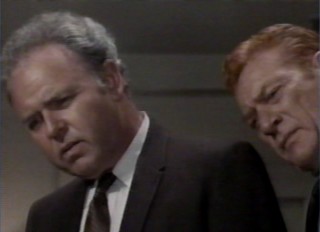 |
| Carroll O'Connor and Kenneth Tobey as Christie and Fred. |
 |
| Bruce Lee as Winslow Wong, mob enforcer. |
 |
| William Daniels as Crowell, the agent. |
Cannell's name brings us to the other point of note: The movie is all but an early pilot for The Rockford Files. It almost certainly was the inspiration. Garner's Marlowe, both in manner and wisecracks, is the prototype of Jim Rockford. He's persistent, or stubborn as the situation warrants, rather than aggressive, as likely to match a punch with a witty jab as with a counterpunch; and even some of his best quips from the movie will make their way into the show.. He breakfasts on Oreo cookies. The major differences between Marlowe and Rockford can be attributed to inflation: Philip works for one hundred dollars a day plus expenses, while Jim gets two hundred, and Marlowe's drab office in the famous Bradbury Building is far more upscale than Rockford's Malibu trailer. Rita Moreno became a recurring guest star in the series and in the later Rockford movies, as the proverbial hooker with the heart of gold. Daniels, Wynant, Tobey and Stevens all had guest roles on Rockford.
Tuesday, September 13, 2011
Talk Like Gene Weingarten Day.
Everyone buy a helium balloon on October 2 to participate in what I hereby designate Talk Like Gene Weingarten Day.
Sunday, September 11, 2011
The Un-American Woodshop.
That title is both inaccurate and unfair. There is something definitely American in the wholehearted embrace of whizbang technology in Scott Phillips' The American Woodshop. And there is nothing at all unpatriotic about the show or its host. They are both Red-White-and-Blue through and through. But, man, both the show and the host annoy me until the cows come home driving a tricked-out Caddy SUV.
Some of it is born of envy, I happily admit. The man's workshop probably cost three or four times more than my house to build. The woodworking machinery alone probably is worth more than my house right now. There is nothing un-American about envy, either. But what really turns me green is the waste.
I have a rum gut, so it doesn't take much to get me queasy. The way this guy runs through wood is truly American. He takes some beautiful salvaged wood, wood that is a century or more from the tree, and turns it into pure crap. And he just tosses away enough wood to make any other woodworker cry.
On one show he took a 6X6 walnut beam, saved from a demolished 19th Century barn -- (so the real dimensions were almost at the nominal), and planed it down to four-by. Then what did he do? He chopped it into foot-long lengths, and shaved off the outer half-inch of each block to make the sides and ends for some walnut drawers! And threw away the rest. He couldn't make eight sides from one block? No, of course not. That would be both economical and sensible. That's pretty bad, isn't it? Don't get your bowel strangulated. There's worse. How did he make the drawers? Dovetails perhaps? Box joints? Nope. Super Glue.
Speaking of dovetails. The gauge of a workman's skill is his dovetails. That's one of the maxims of woodworking. They print it on T-shirts. So, it's practically a tenet. You know that Scott Phillips is about to sin against it with all his might whenever he recites it religiously. Craftsmen make dovetails with a saw and chisels. Some do it by eye, others do the layout with a bevel and square. I'm no master carpenter. My dovetails always have irregularities, and sometime even a gap that needs to be filled with a sliver of wood. But they are honest, hand-made, workmanlike dovetails. Scott Phillips does them with a thousand dollar jig and a power router. The only skill involved in making his dovetails is in locking down the wood in the jig.
Give me Roy Underhill any day. He might be a fundamentalist, but his work is authentic, in every sense.
Friday, September 2, 2011
The Postal Service and Me.
June 25, 2010.
Inside the mail box, atop the familiar glossy invitation from a local car dealer to "Scratch and Win," there is an unusual piece of paper. It is slightly off-white and printed with green lettering. It is a form. At the top are two drawings of mail boxes, such as you might see lining the streets of any suburban or rural road. One is forlorn and rather decrepit. The other is spruce and chipper. They might be pictures of the same box, one drawn in some happier time, when life seemed full of hope and promise, the other, after years of toil and weather, in it's old age, filled with despair and dark thoughts of death. The legend asks, "Which one looks like your mail box?"
The implication, of course, is clear.
The form is designed to register complaints about the state of one's mailbox, with two columns of check boxes, each box accompanied by a curt description of some possible potential grievance. "Your box is not an approved box." "The door needs attention." "Box must be located so carrier can serve it without leaving vehicle." "Your box is not waterproof." "Your box should be raised (blank) inches." CHECK.
The check mark is further annotated, in an impressive cursive script, at the bottom of the form. "20. Other faults. 'Box must be 42 " from road to bottom of box.'"
First thing to do, obviously is look at box. It's old. The house it serves was built in the 1960s, and is located in a rural subdivision in North Central Florida. Cattle and horses are still being raised nearby. The roads are kept paved by the homeowners association. There are five houses on a street about one half mile long. Two of the other houses are contemporaries of this one, while the other two are products of the early stages of the recent housing boom/bust. Beyond this house, the electric power line extends one more pole and then ends abruptly at vacant lots that run to the end of the street. It is, as I say, rural.
One of the things I noticed shortly after buying the house 15 and a half years ago was the number scratched into the dull aluminum of the mail box. It is a date, 1972.
So, for 38 years, the box has stood by the side of the road, faithfully discharging its Postmaster Approved duties, through hurricanes and hundred degree temperatures in the summer and freezing temperatures and gale-force winds in the winter. It has been there almost since the establishment of the U.S. Postal Service in 1970. Richard Nixon was president, running one of the most corrupt administrations in American history. Every month back then about 1,000 U.S. service men were being killed in Vietnam. Ah, good times.
Now, the box is an outlaw. OK, it's thirty-four inches from the road surface to the bottom of the box. So what? It's been there 38 years. Nobody has complained about it in the last 15 years. Why now?
July 1.
My weekly trip into town. 18 miles round trip. Everything I need to do for the week, that cannot be done at home -- grocery shopping, banking, prescription filling, gassing up the car, everything, has to be done that one day. It's that way every week. One day a week, for two hours. I decide to add something to the usual to-do list: Visit the Post Office and ask about The Notice.
The first clerk I speak to throws up her hands and says, laughing, "You aren't going to talk to me about that!" The two other clerks also laugh. She does take The Notice. After reading, she gives it her best shot, basically repeating what is on the page. She then tells me that the Postmaster is not here, but I can speak to the Supervisor, if I want. I want. She goes away into the back of the building and, in a minute of so, the Supervisor walks to the counter.
He reads The Notice. He explains, using pretty much the same wording as The Notice. I inform him that the box has been there 38 years. "Why is it so important now to raise the box?" He explains that the Postmaster has been trying for three years to get boxes in the area up to Standard. He has sent out notices. The Supervisor has driven around and sent out notices. I object that I have received no such notice prior to The Notice. The Supervisor says that the previous notices were given to the Carriers. Perhaps, he suggests, the Carriers, for their own reasons, did not deliver them. This time the Postmaster has personally put The Notice in my box. I suggest that the fact that the box has worked just fine for THIRTY EIGHT YEARS indicates that there is no need to change it now. I further suggest it is not exactly good public relations, when the Postal Service is running a 6.7 billion dollar annual deficit, to waster time and money antagonizing customers. The Supervisor demurs, but says that the Postmaster, his boss, makes the final decision. He, the Supervisor, cannot reverse the Postmaster. He gives me the telephone number and the name of the Postmaster. I should call that afternoon. I observe that it sounds unlikely that the Postmaster will change his mind. The Supervisor offers that, on occasion, the Postmaster has been known to reverse himself. I wish the Supervisor a Happy Independence Day.
That afternoon, I call the Post Office, hoping to speak to the Postmaster. "This line is busy," the voice of Ma Bell informs me. I try again later. "This line is busy," Ma Bell repeats. I give up.
July 7.
The Federal holiday is over. I am, like the country, a year older. Sheer coincidence, but I am feeling not happy. The Notice has been a magnet for my eyes and thoughts. I have been stewing. I decide that, failing to meet the Postmaster in person, and being unable to reach him by telephone, the Devil's instrument, I shall write a letter. I write a letter. It is brief. I enclose photographic evidence of the date on the box. I argue that the simple fact of long usage is sufficient to demonstrate that the box is serving its purpose adequately. I make the deficit point. I am courteous but firm. I mail the letter.
July 9.
Deadline day. Nothing.
July 10.
D-Day plus one. Nothing.
July 12-16.
Nothing. I begin to notice Nothing.
July 17.
I put a letter in the box. At the end of the day, it is still there. Perhaps I missed the Carrier. She sometimes arrives early.
July 19.
I put the letter in the box. Early. At 3:00 p.m. it is still there.
I call the Post Office. Surprisingly, I get through. I ask for the Postmaster.
We go over the familiar ground again. By now, I am a bit annoyed. I point out that there are others, perhaps hundreds, of mailboxes on the route, many of them much lower than my own. The Postmaster suggests that the owners of those boxes will be noticing that they, too, are not receiving their mail. I suggest that this is highly irresponsible, as there are people who depend upon the U.S. Mail for their pensions, their medications, who pay their utility and mortgage bills through the postal service. Is the Postmaster willing to put the incomes, homes and even the lives of those people at risk? Apparently, so. It is not his fault. When I reach the end of my arguments, the Postmaster is unmoved. I play what I believe to be my trump card.
Why did he not reply to my letter of protest before discontinuing mail service?
"You didn't include your telephone number. I couldn't reach you."
I burst out laughing.
The Postmaster could not reach me without my phone number.
I had to apologize for my outburst, but I was still laughing when I hung up.
The Man had won again.
Saturday, August 6, 2011

Friday, August 5, 2011
Winner of the Tom Toles Obama Birthday Cartoon Contest
Tom Toles of The Washington Post, Pulitzer-prize-winning Tom Toles, conducted another of his cartoon caption contests, this time to supply a caption for an editorial cartoon commemorating President Obama's 50th birthday. The winner is here. Four out of the top ten finalists is not bad, either.
Monday, July 11, 2011
The Greatest Woodworking Tool Ever.
It slices, it dices, it juliennes, it purees.
The Stanley "55" Plane, the Universal Combination Plane, "A Planing Mill Within Itself." The height of 19th Century manual tool invention, the Stanley 55 combined a shelf-full of molding planes with rabbet, plow, dado, filletster, match, beading, sash and slitting planes. It is certainly the most versatile hand tool ever created, and, when properly adjusted, the most useful. It is, also, unfortunately the most intimidating tool imaginable.

An elaboration of the Stanley 45, which was already an advanced combination plane (above), the 55 looks like a something from a modern steam punk fantasy.

The two fences make the plane formidable, but, although Stanley recommended that both fences be used whenever possible, the 55 could be used most of the time with one fence on the left side.
 It could even be used for most purposes without the "tower", the adjustable center bottom, or skate, which provided a third supporting surface for the cutters or plane irons used in making moldings with both convex and concave profiles.
The fact that the plane could serve so many purposes meant that it had to be set up properly when the purpose changed. The adjustments were many, and precision was not only possible but necessary. This precision capability/necessity led to some people calling the plane finicky. They compared it to the dedicated molding planes, which, at most, had one adjustment, that for depth. While not really a fair criticism -- after all the plane was doing the work of a dozen or more planes, it has had the effect of giving the plane a reputation for being difficult to use. Use is seldom a problem, in fact. If the plane is reduced to only the necessary elements for the particular purpose at hand, the actual number of adjustments needed is small. Once they have been made, the plane will cut even a complex molding profile quickly and easily.
Saturday, June 11, 2011
Googlenopenolifeatall.
Google is reportedly working on a solution to the problem, created by Google, and first recognized by Gene Weingarten, "humor" columnist of The Washington Post, of the evanescence of original phrasing in the English language.
In the past, a writer could invent a neophrase, a new sequence of words, and it would linger in the literary atmosphere, perhaps for years, as something unique. Then along came the Google spider and soon phrases were being sucked up into the interwebs at the speed of cyberthought, their lifeless carcases cataloged almost the instant that they hit the electronic fly-paper in the personal computer. Phrases that were not caught in Google's virtually infinitely-fine silk sieve became more and more rare and more and more short-lived (not to mention, more and more strained). Gene Weingarten recognized this fact, and coined the word googlenope for the phrase, enclosed by quotations, that returned no hits in a Google search. The word "googlenope" was itself a googlenope only briefly.
Now Google has attacked the problem with its trademark™ brutal force, and come up with the WhatNow® (Weingarten heuristic automatic thesaurus-like natural omni-phrasing wanker), a computer program that does nothing all day but create new English language phrases that can be stored in Google's computer banks, thereby rendering the googlenope extinct. "This is not a swipe at Mr. Weingarten. We are merely protecting our intellectual property," said Google's Sergey Bryn. The googlenope is predicted to have a googlenopenolife at all in the future.
Monday, November 1, 2010
Sherlock: The Blind Wanker.
I estimated in the previous post that this Sherlock had about 50 percent of the brain wattage of the real Holmes. This week I am revising that estimate downward by another 50 percent. This Sherlock makes the odd observation when it suits the plot, but when it is auctorially necessary Sherlock is conveniently blind. Three times during the episode Sherlock misses important clues that are right in front of him, in one case literally right in front of his nose. He does not see the jade hairpin in Lukis' PA/lover's hairdo, even though he is looking over her shoulder as she is working at her computer. The real Holmes would have seen and recognized the importance of the pin, especially as Sherlock was already aware that Lukis had been killed for stealing from someone on his most recent trip to China. Sherlock misses the partial translation on the photo of the graffiti. Even more egregious, in a lame PC bow to the "need" to make the female love-interest more than simply a Victorian victim, he is shown up by Sarah, Watson's latest candidate for the next Mrs. Watson, who points it out. And, then, while he is standing not twenty feet from the doorway of 221B, Watson and Sarah are abducted from the flat by Tong members who walked in by the front entrance!
Nothing, however, can compare to the idiocy of the earlier culmination of the search for the elusive witness, Soo Lin, the young Chinese woman who can provide the secret of the cipher. Having stressed the importance of finding her before the agents of the Tong can silence her, Sherlock and Watson track her back to the museum where she has concealed herself. Then, during the vitally important questioning of her about the cipher, they are interrupted by the evident arrival of the assassin. What to do? What to do? WWSHD? Well, the logical thing to do would be to fortify the room and protect their witness. Lure the assassin to them, where he might be trapped. That is what the real Sherlock Holmes would do. So no chance of this Sherlock doing it. Instead, run, run like the northwind out of the room, leaving Watson to hold the unfortified position. And what is Sherlock's plan? To dash around aimlessly while the killer shoots at him. Naturally, the killer is hopeless at shooting. And none of his shots actually cause any damage to the museum or its exhibits. They just make ping-zinging noises. And then, to top off the idiocy, Watson decides that it is more important to "help" Sherlock, by also running out, than to stay and to defend their witness. (Which, after all, is what they came to do.) How is he planning to help? He's a soldier. We have seen him shoot a man. He must have come out armed, right? No, of course not. The real Watson would do that, but this is not the real Watson. He's not even the wooly-headed Nigel Bruce, who always went armed into trouble. Watson's plan is the same as Sherlock's, to dash around aimlessly. It's a consistent plan, to be sure. The natural result is that the witness, alone and unprotected, is murdered. Brilliant! They couldn't have done better to further the plot, the plot of the Tong, that is.
And speaking of the Tong plot, really? They suspect one of three people of stealing the jade pin. So their strategy is to vandalize a museum, a library and a bank, leaving graffiti? Really? They cannot simply grab them, as they did Watson and Sarah? What does the graffiti accomplish, except to expose them to public and official scrutiny? And speaking of grabbing Watson and Sarah, really? They have observed Sherlock and Watson, and they don't know which is which? All Englishmen look alike? The Tong has never heard of the internet? Granted, Google might be censored in China, but Sherlock has a website, and his picture has been in the news online and in print. So, really, they don't know what he looks like? And even assuming that they couldn't do an online search, Moriarty sponsored their entry to the UK. He didn't send them a massive dossier on Sherlock? Really?
We need hardly mention the ludicrous and numerous Clouseau-Kato hand-to-hand battles in which Sherlock engages throughout the episode. The one in the tunnel while Sarah is waiting to be impaled by the Mwahaha villain's (the sham Fu Manchu General Shan) catapult bolt is remarkable for its silliness. (And repetitiveness, being a duplicate of the earlier strangulations.) And the Mwahaha villain's impression of Dr. Evil is spot-on. As Seth Green might say, "Just pop a cap in his ass!" And when she actually tries to shoot Holmes, what is his counter? To tell her that the muzzle velocity of her gun when calculated against the curvature of the walls of the tunnel will likely result in a dangerous ricochet, which might harm one of her henchmen. HUH? It's gibberish. What the hell does the curvature of the walls have to do with the travel of the bullet away from her? And what does one wounded henchman mean in the great Tong scheme of things?
Is this really the 21st Century's best effort at updating Holmes -- a buffoon in a parody of The Pink Panther? Yes, so it appears.
Verdict: Sinking fast.
Friday, October 29, 2010
A Study in Brown.

A Sherlock for the 21st Century
Sherlock Holmes was to be updated, modernized, brought into the contemporary scene -- so ran the announcements late in 2009. Hardly the first time that Holmes had been brought forward from his native Victorian milieu and settled among a generation removed from that era by decades of world-altering events. Had not Universal and Basil Rathbone leaped fifty years from the paradoxical 20th Century Fox's Adventures of Sherlock Holmes, set in the late 19th Century, to the series of iconic 65 minute B-movies set during the 1940s and World War II? At least twice he he had been cryogenically frozen and revived, once for a TV movie in the 1980s (The Return of Sherlock Holmes, 1987, with Margaret Colin as Jane Watson, and Michael Pennington as Holmes.) and again in a cartoon series set in the 25th Century.
Holmes has survived his creator's attempt to kill him with some risible prose and a plunge over Reichenbach falls, hundreds of mediocre or worse adaptations and pastiches, parodies and dotty impersonators (Judge Justin Playfair of They Might Be Giants being among the better versions of a mad Holmes). And then there are the imitations that are spread across current television channels.
Foremost among the imitations is Dr. Gregory House, M.D., who practices medicine and Sherlockian inferences on House, M.D., oddly enough, on Newscorp's FOX, the modern incarnation of the great studio. House not only has taken possession of Holmes' old address, but he takes over Holmes' source, Dr. Joseph Bell, the mentor of Dr. Arthur Conan Doyle. It was Bell who astounded the young Doyle with his perception and deductive ability, as he accurately read his patients' jobs, habits, places of residence and familiar relations from clues gathered by quick examinations of their persons. Second among the current imitations is Patrick Jane, The Mentalist. Jane exercises the same perception and penetration, but with crime-solving rather than medicine as his field. He is mocking and heedless of authority, even as he works with the police. He sees to the bottom of the criminal rather than the crime. It becomes a test of minds for Jane, who delights in outthinking murderers. A true spiritual son of Holmes. Least of these is Adrian Monk. If these copies can succeed in the modern world, despite all the advances in technology and information gathering, why not, then, the original, the Master Detective himself?
All the old cautions apply, beginning with the one, "In theory..." Yes, it could work, and you would imagine that, having come up with the notion of re-creating Holmes in the present, the idea would be auto-completing, like the software that intuits your typing on Google. But it's not that easy. It takes a visionary mind to translate Macbeth to another culture. It takes a mediocre mind to advance Sherlock Holmes a century within his own culture. The type of mind it took to produce "Sherlock" is mercifully hidden from me.
One would expect the modern Holmes, or Sherlock as we must henceforth call him, to possess the same character traits -- the comprehensive genius, the obsessive concentration, the scalpel-like incisiveness, the shortness of temper that comes with a mind that is always straining against the plodding of mundane reality, but expressed in the idiom of today. All the long-cherished features of the character would beam out in a new and shinier 2.0 release. Whatever. What we get is a collection of tics passed off as traits. Or, to continue the software metaphor, we get all the bugs and none of the features. The new Sherlock owes more to Adrian Monk than to his forebear. And if that were not sufficiently annoying, the production delights in its debt to Numb3rs, from which its visual style steals all the gimmicks but none of the solidity. We see Sherlock observing and examining, and, for some unfathomable reason, each observation and factoid must be labeled on-screen for those in the viewing audience who cannot wait thirty seconds. Yes, because in thirty seconds Sherlock will explain everything he has seen and all that he has deduced during his examination of the scene. What, then, do the labels accomplish? They provide a display. For viewers with an attention span conditioned by the refresh rate of an LCD pixel, there must be some ever-changing optical stimulation, lest they become comatose before the character can speak.
But that's not all! There's less! Not satisfied with reducing Sherlock to a narrow set of quirks, the producers have deprived him of about half the wattage of his massive brain. Sherlock has not gone Green. No, he has gone brown, as in brownout, or the color of diarrhea. Whereas the original Holmes could divine the essence of a case in the bare clues of the Lauriston Gardens murder, setting his snares and revealing all only after the criminal had been captured, the new Sherlock has to have the crime explained to him by the killer himself. Sherlock blunders ahead, making the trademark brilliant observations about everyone and everything, but completely in the dark about the criminal he is supposedly searching out with laser-like intensity. Holmes knew everything about Jefferson Hope after a few minutes in A Study in Scarlet. In A Study in Pink, he knows nothing until the last few minutes. Even the basics of human nature, which Holmes understood with clinical precision, and knew to be necessary to the understanding of the criminal mind, elude Sherlock, who finds such essentials of criminal investigation "boring." And then there are the outright stupidities. The most glaring of which occurs when a policeman calls Sherlock "our favorite psychopath." Sherlock, in a frenzy, wheels upon him and shouts, "I'm not a psychopath, Anderson. I'm a high-functioning sociopath. Do your research." Do your research, indeed. Apart from the redundancy of "high-functioning sociopath," that line reeks of TV profiling, wherein some writer has taken the catchy "high-functioning schizophrenic" and combined it with the ever-popular sociopath to form what sounds like a convincing classification of psych disorder. The real Holmes, the real modern Holmes, would know, would be intimately knowledgeable about, the DSM IV psychiatric diagnosis of Antisocial Personality Disorder, which is the real term used by real doctors to classify the popularisms psychopath and sociopath. This Sherlock is not the great detective with the scientific method coded in his DNA and expressed like bioluminescence. This Sherlock is a mutant, whose defective genes are coded with some weird albinism that mimics brilliance.
But he is modern, with all the vapidity that the term implies. I give him that.
A footnote: The business of the police mistakenly calling the string of murders suicides is lifted from the Rathbone movie, The Spider Woman, one of the better entries in the Universal series. You would think that, what with the Holmes canon being in the public domain with the lapse of 75 years since Conan Doyle's death in 1932, the producers would have plenty of material to pollute without dipping their feet into movie adaptations, but they seem to have sunk well below even such low expectations.
"Sherlock" at PBS Masterpiece. Sunday Oct. 24, 2010.
Monday, July 12, 2010
The Fiddler in the Subway: A review
Print journalism is dying, they say. The evidence is all around us. The shrunken corpses of once mighty newspapers lie crumpled and discarded, soon to vanish on the next puff of wind. Great buildings that once had throbbed with huge machinery, devouring paper forests and drinking ink rivers, are veritable whited sepulchers, empty and silent, empty even of echoes. The universe, too, is winding down, if we are to believe the reports. Nothing lasts forever. But there are yet bright spots in the darkness. That is one of the corollaries of entropy. Some papers are still turning out thoughtful work. The Washington Post is one of those bright spots. Yes, it has suffered along with the rest of the industry, but it has fought back. There are still reasons why print journalism matters. Gene Weingarten, more often than not, is one of those reasons. The articles collected in this book demonstrate why newspapers were and continue to be necessary. Nowhere else can you find writing this good about subjects that, however unlikely to warrant attention some may seem, should be noticed. Newspapers make this kind of writing possible.
The topics run the gamut from b to b, baseball to babies. Well, there are some other letters, too. There is great reporting in The First Father, an investigation that begins in the dark, literally, and ends up bringing to light the hidden story of Bill Clinton's biological father, W.J. Blythe. There is the search for the Armpit of America, in which our intrepid reporter has to stumble upon something nice to say about Battle Mountain, Nevada. And then there are the two pieces for which Pulitzer prizes in Feature Writing were awarded: the title story, The Fiddler in the Subway (originally titled Pearls Before Breakfast), the story of what happens when an audacious but simple stunt turns into a wildly successful feature, reprinted everywhere, and Fatal Distraction, an unflinching look into a grievous modern-day trend, the deaths of children through inattention.
Those are the topics, but the real subjects of all the included articles are lurking in the background. They are two, the more potent of whom is Time. For it is Time that stalks through each of these journalistic essays. Journalism is, after all, the record of what happened in the day. Time the patient, inexorable hunter, whose arrows fly but one way, straight into the heart, is the prime mover of all these works. The time since Roger Maris broke Babe Ruth's single season home run record. The instant of time it takes to forget a child in the back seat of a locked car. Time to stop and listen to the falling of the rose petals of a violin concert, the notes almost drowned out by the tread of the mundane. And the second subject? Time has a companion, a bloodhound, who lopes along before his master. But the bloodhound likes to pause and circle and backtrack when it comes upon an interesting scent. It likes to dig in the most peculiar places, and often in the most disgusting messes. Its gait is loose, sloppy, leisurely. It is the reporter. You glimpse him now and then, but it is his voice that you hear downwind, seemingly far off at times, but insistent. Yes, it is the reporter and Time who are the real subjects. So, when the obituary for print journalism is finally written, there is one person who should be chosen to write it: Dave Barry. Gene Weingarten will be busy sniffing under some rock, trying to make sense of it all.
Wednesday, March 24, 2010


Tuesday, March 23, 2010

Friday, March 19, 2010
Proposed New Jersey Turnpike Rest Area
Elisabeth Shue Rest Area. Food. Restrooms. Gag'n'Go.
Evidently, this was too much for The Washington Post website. Despite that Ms. Shue has made a movie, Gracie, which is a fictionalized account of her teenage battle with bulimia, and has appeared on national television with her brother to discuss the subject, it is impossible to refer to it in jest in comments about a humor column.
Evidently, this was too much for The Washington Post website. Despite that Ms. Shue has made a movie, Gracie, which is a fictionalized account of her teenage battle with bulimia, and has appeared on national television with her brother to discuss the subject, it is impossible to refer to it in jest in comments about a humor column.
Tuesday, March 9, 2010

Subscribe to:
Posts (Atom)